The Rule of the Nagual
Source note: This article treats Carlos Castaneda’s published books as the primary corpus. It describes what the texts report; it does not present their cosmology as independently established fact. Page numbers vary by edition, so references emphasize book, part, and chapter.
Overview
In Castaneda’s works, the Rule of the Nagual is the governing design for a traditional party of warriors and for the transmission of that party’s purpose from one generation to the next. It defines the Nagual’s function, the energetic types assigned to a party, the relationship between dreamers and stalkers, the role of the Nagual woman, and the cycle by which one party prepares successors before attempting its “definitive journey.”
The fullest formal account appears in The Eagle’s Gift, Part Three, especially chapters 9–12. There the Rule is presented through Castaneda’s recollection of teachings delivered by don Juan in heightened awareness. The same book calls the Rule both a myth and a map: it first appears as a mythic account of the Eagle, but is meant to become a pragmatic guide whose claims are tested through interaction with actual warriors. Don Juan also says that only the portion concerning the Nagual and his party is being disclosed; the complete Rule is described as effectively endless and as covering the conduct of a warrior more broadly.
This meaning should not be confused with the earlier “rule of an ally” in The Teachings of Don Juan. That earlier use refers to the prescribed procedures for handling a particular ally. Castaneda’s structural analysis calls it a rigid organizing framework transmitted from teacher to apprentice. It is conceptually distinct from the later Rule governing a Nagual’s party.
Three meanings of “Nagual”
The books use nagual in several related but nonidentical ways:
-
The nagual as the unknown or left-side awareness. In the tonal–nagual distinction, the tonal is the ordered field of ordinary awareness, while the nagual designates the unknown, the second attention, or that which cannot be encompassed by ordinary description.
-
The Nagual as a person or office. A Nagual is a particular seer whose energetic configuration enables leadership and responsibility for a party. Later formulations emphasize that being a Nagual is not merely possessing unusual energy; it entails being a leader, teacher, and guide.
-
The Rule of the Nagual. This is the design governing the Nagual’s party, its types, its organization, its succession, and its movement toward freedom. In The Eagle’s Gift, becoming a Nagual requires both the appropriate “double” configuration and the disclosure, understanding, and acceptance of the Rule.
The title of this article refers primarily to the third meaning, while drawing on the first two where the books explicitly connect them.
The Rule as a character-reported cosmology
The Eagle and the opening to freedom
In the teaching reported in The Eagle’s Gift, “the Eagle” is a seer’s image for the impersonal power governing living beings. At death, ordinary awareness is said to return to and be consumed by this power. The Rule nevertheless asserts that living beings have been given a possibility of retaining awareness by finding an opening to freedom. The Nagual exists to guide beings toward that opening.
These statements should be read at the correct evidentiary level:
- Textual fact: Castaneda’s book reports this teaching.
- Character-reported teaching: Within the narrative, don Juan attributes it to the accumulated seeing of generations of seers.
- Not independently established: The book does not supply external evidence by which the Eagle, the opening, or the retention of awareness can be historically or scientifically verified.
Myth, map, and pragmatic directive
Don Juan reportedly distinguishes three stages in understanding the Rule:
- receiving it as a map;
- grasping the possibility of an expanded or “paramount” awareness;
- encountering what the text calls an actual passage into another world of awareness.
He says that he initially made the mistake of interpreting the passageway too literally. His later teaching strategy was designed to prevent his apprentices from becoming fixed on a physical opening while still treating the Rule as operational rather than merely symbolic.
The distinction is important. Calling the Rule a “myth” does not mean that the narrative dismisses it as fiction. Within don Juan’s teaching, myth is the first form in which a structure is received; the structure becomes a map when its types and relationships are allegedly corroborated in practice.
The traditional four-pronged structure
The following is the ideal structure described in The Eagle’s Gift. It should not be imposed on every party mentioned elsewhere in the corpus.
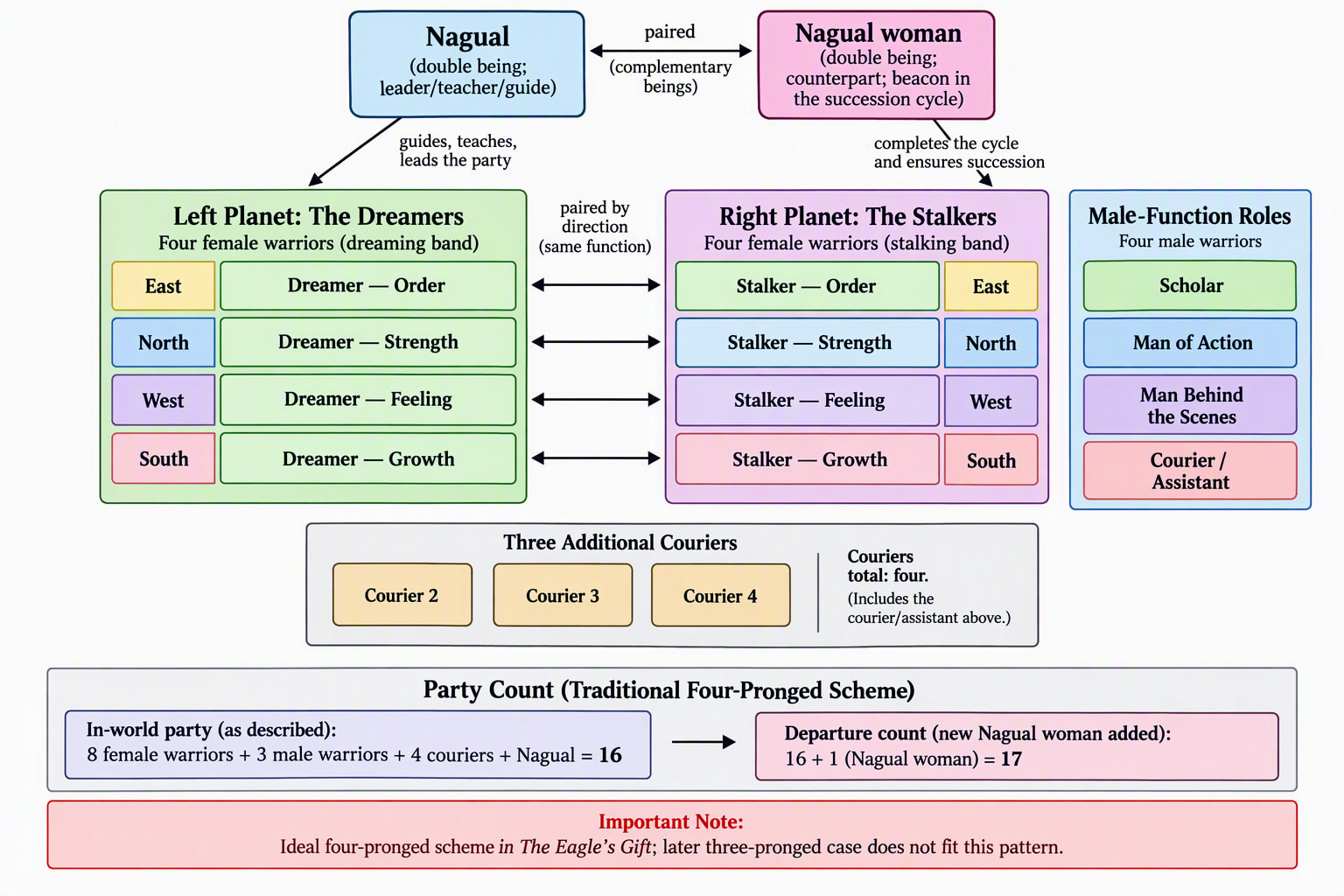
Figure 1: Traditional four-pronged party structure in The Eagle’s Gift, chapter 9. This is the Rule’s ideal scheme, not a claim that every later group conformed to it.
The Nagual and Nagual woman
The traditional account begins with a Nagual man and Nagual woman, both described as double beings. The Nagual pair is charged with nourishing, enhancing, and leading the warriors assigned to them. The male and female Naguals are not presented merely as ordinary spouses or as interchangeable titles; they form a functional pair within the succession cycle.
A later formulation in The Active Side of Infinity says that a Nagual may be male or female and that, since the time of the nagual Lujan, the lineage had operated through a joint nexus: the man contributing sobriety and the woman innovation. That same passage, however, has don Juan call himself a solitary sorcerer and say that no Nagual woman was then in his life. The book does not explicitly reconcile this preliminary disclosure with the fuller account of his party and Nagual woman in The Eagle’s Gift.
Female warriors: four directions in two bands
The formal party has eight female warriors, arranged as four directional pairs. Each direction has one stalker and one dreamer:
| Direction | Name or quality | General characterization in the Rule |
|---|---|---|
| East | Order | Light, optimistic, smooth, persistent |
| North | Strength | Direct, resourceful, forceful, tenacious |
| West | Feeling | Introspective, cunning, somber, indirect |
| South | Growth | Nurturing, warm, shy, expansive |
The four stalkers form the right planet; the four dreamers form the left planet. Each dreamer corresponds to a stalker of the same direction. The Rule describes the two women of a direction as mirrors who challenge one another toward impeccability.
The directional classification is therefore not simply geographic. It combines:
- energetic configuration as perceived by seers;
- characteristic mood or temperament;
- membership in the dreamer or stalker band;
- partnership with the complementary woman of the same direction.
Dreamers and stalkers
The texts do not say that only the designated dreamers dream or that only the designated stalkers stalk. All members may practice both arts. The distinction marks who becomes a foremost specialist in each domain.
The Eagle’s Gift associates:
- dreamers with the second attention and controlled dreaming;
- stalkers with the first attention, ordinary affairs, controlled folly, and dealings with people.
The book explicitly calls the stalkers the practical managers of the everyday world, while the dreamers specialize in the disciplined use of dreaming.
Male warriors and the first courier
The minimal group initially assigned to the Nagual pair also includes three male warriors and one courier, representing four types of male activity:
- the scholar or man of knowledge;
- the man of action;
- the man behind the scenes;
- the courier or assistant.
These are functional types, not a ladder of rank. The text says that the four men can operate together as a unit or separately according to need.
Additional couriers
After the initial party is formed, the Rule calls for three additional couriers, producing four couriers in total. Couriers may be male or female, but the text assigns specific type requirements: male couriers correspond to the assistant type, while female couriers are associated with the south.
Couriers are not merely servants. In the account of Emilito, a courier travels ahead of the Nagual as a scout, reaching toward the limits of the second attention and reporting what has been witnessed.
Traditional count
The ideal in-world party is stated as:
- eight female warriors;
- three male warriors;
- four couriers;
- the Nagual.
This gives sixteen under the Nagual’s leadership. At departure, the new Nagual woman joins the departing party as its seventeenth member. Additional warriors, if present, are to be added in multiples of four.
Don Juan’s party as an enacted form of the Rule
The Fire from Within presents don Juan’s party as eight female seers, three male seers, and four couriers. It names the female warriors as Cecilia, Delia, Hermelinda, Carmela, Nelida, Florinda, Zuleica, and Zoila; the male warriors as Vicente, Silvio Manuel, and Genaro; and the couriers as Emilito, John Tuma, Marta, and Teresa.
The Eagle’s Gift supplies the directional arrangement:
| Direction | Dreamer | Stalker | Associated man | Courier/household |
|---|---|---|---|---|
| South | Cecilia | Delia | — | Emilito and Teresa |
| East | Hermelinda | Carmela | Vicente, scholar | Juan Tuma |
| West | Zuleica | Zoila | Silvio Manuel, man behind the scenes | Marta |
| North | Nelida | Florinda | Genaro, man of action | — |
The book acknowledges that the party can be viewed either as functional groups or as four households. The members are not said to form a simple command hierarchy; the arrangements are situational and complementary.
Silvio Manuel is called the “actual leader” of the party during Castaneda’s introduction to the west, even though don Juan is the Nagual. Elsewhere he is described as the silent force behind don Juan. This suggests a distinction between the Nagual’s overall responsibility and a warrior’s operational leadership in a specific domain, rather than two competing Naguals.+1
Formation, leadership, and succession
Formation of a party
The ideal sequence is not mechanical recruitment. In the narrative, the prior party searches for people whose luminous configurations correspond to the Rule. The prospective Nagual must then secure their participation and train them. Don Juan says that his benefactor altered the expected sequence because don Juan was not yet prepared to assume responsibility for a Nagual woman. This is an explicit example of individual interpretation modifying implementation without discarding the Rule.
Leadership is therefore presented as adaptive. Don Juan contrasts his benefactor’s severe method—forcing people to help themselves—with his own more direct method of placing apprentices in situations they had to face. The Rule supplies the design, but each Nagual interprets its application.
The Nagual woman as counterpart and beacon
In the mythic succession pattern, the Nagual woman eventually leaves with the preceding party and serves as a beacon for the party that remains behind. The new Nagual man stays in the world to repeat the cycle: gather a party, recover totality, prepare successors, and lead his warriors toward freedom.
Don Juan’s own Nagual woman is called Olinda in The Eagle’s Gift. After joining his group, she and don Juan are said to have worked together to find the four female dreamers and the remaining couriers. When the prior party departed, that party took Olinda with it in accordance with the traditional cycle.
Carlos Castaneda’s counterpart is identified as Carol in The Fire from Within. That book also calls Castaneda the nominal leader of the new party.
Continuity
The traditional party’s final duty is not simply its own departure. Before leaving, it must locate a new pair of double beings, reveal the Rule to them, and provide the nucleus of a successor party. In that sense, the Rule joins freedom to continuity: a party cannot treat its own escape as separate from transmitting the possibility to another generation.
The Active Side of Infinity likewise describes the Nagual’s search for a successor with the energetic configuration needed to continue the lineage.
Freedom, totality, and the third attention
The Rule’s stated goal is not immortality in the ordinary sense. Don Juan says it concerns retaining the awareness normally relinquished at death. He connects successful crossing with the third attention, depicted as the whole body becoming aware of itself as a totality. He also concedes that this condition cannot be adequately explained by ordinary, compartmentalized thought.
The Fire from Within elaborates the three attentions:
- the first attention orders the everyday world;
- the second attention engages unused possibilities within the human field;
- the third attention involves the entire luminous structure becoming kindled at once.
The new seers’ aim is to reach that condition while alive and conscious rather than encounter it only at death.
Within this framework, “remembering oneself” is not ordinary autobiographical memory. It is the recovery and integration of experiences associated with the two sides of awareness. In The Eagle’s Gift, breaking the luminous shell, remembering the other self, and attaining the totality of oneself are treated as related stages required before the final journey.
The three-pronged Nagual and the breakdown of the expected pattern
The most important variation appears within The Eagle’s Gift itself.
Don Juan originally attempts to construct Castaneda’s party according to the traditional Rule. The result does not fit:
- the first four women found are dreamers when the anticipated initial group should have been stalkers;
- three women and three men cluster into groups of three rather than four;
- several members cannot function in heightened awareness as expected;
- Castaneda cannot properly lead them.
Silvio Manuel’s seeing eventually identifies the problem: Castaneda only appears to have four energetic compartments but actually has three. The text therefore calls him a three-pronged Nagual belonging to another Rule. Silvio Manuel says that he is not authorized to reveal that Rule and that a courier carrying it must appear at the appropriate time.
This passage prevents the four-pronged schema from being treated as universally exhaustive. It also leaves major questions unresolved: the published books never provide a comparably complete formal description of the three-pronged Rule.
Ambiguities and textual variations
1. Ideal structure versus historical parties
The Rule gives a sixteen-member ideal, yet The Fire from Within says that earlier Naguals in the lineage had groups ranging from seven to fifteen seers. The text does not explain whether this reflects incomplete parties, different counting conventions, flexible historical formations, or other Rules.
2. Four compartments, three compartments, and “doubleness”
The Eagle’s Gift describes the traditional Nagual as a four-compartment luminous being, while The Active Side of Infinity describes a Nagual as two fused spheres. The Fire from Within says that some prospective Naguals appear to have four parts and some three. These descriptions may be different views of energetic structure, but the books do not formally reconcile their terminology.+1
3. Fourteen Naguals versus twenty-seven generations
The Fire from Within reports fourteen Naguals in the lineage and describes a major reorganization after 1723. The Active Side of Infinity later speaks of twenty-seven successive generations. No explicit reconciliation is given. The safest reading is to preserve both statements rather than silently harmonize them.+1
4. Universal and individual interpretation
The books themselves anticipate variation by distinguishing:
- universal interpretation: accepting the Rule’s broad statements as given;
- individual interpretation: a seer’s practical conclusion about how those statements apply in a particular situation.
This provides a textual basis for adaptive implementation, but it does not authorize readers to invent missing roles or complete undocumented Rules.
Related Wiki topics
Suggested internal links:
- [[Nagual]]
- [[Tonal and Nagual]]
- [[Nagual Woman]]
- [[Dreaming]]
- [[Stalking]]
- [[Four Directions]]
- [[Warrior’s Party]]
- [[Second Attention]]
- [[Third Attention]]
- [[Assemblage Point]]
- [[Intent]]
- [[The Eagle]]
- [[Totality of Oneself]]
- [[Three-Pronged Nagual]]
Sources
Primary sources
- Carlos Castaneda, The Eagle’s Gift (1981). Part Three, chapters 9–12: “The Rule of the Nagual,” “The Nagual’s Party of Warriors,” “The Nagual Woman,” and “The ‘Not-Doings’ of Silvio Manuel.” This is the principal formal source. The book’s table of contents confirms these consecutive sections.
- Carlos Castaneda, The Fire from Within (1984). Foreword; chapters 5 and 7. Used for don Juan’s party, the role of the Nagual, the attentions, the assemblage point, and the energetic explanation of leadership.+1
- Carlos Castaneda, The Active Side of Infinity (1998). “Who Was Juan Matus, Really?” Used for the later account of the Nagual’s responsibility, male–female joint leadership, doubleness, and succession.
- Carlos Castaneda, The Second Ring of Power (1977). Used for the tonal–nagual distinction and the relation between the first and second attentions.
- Carlos Castaneda, The Teachings of Don Juan (1968). “A Structural Analysis,” especially “An Ally Had a Rule.” Included only to distinguish the earlier ally-specific use of rule from the later Rule of the Nagual.
Source-critical conclusion
The Rule is most accurately represented as a character-reported map of party organization, succession, and the pursuit of freedom within Castaneda’s narrative system. The four-pronged structure is explicit and detailed, but the corpus also explicitly records failed conformity, adaptive interpretation, differently sized historical parties, and a three-pronged Rule that remains largely undisclosed. Any reconstruction that erases those limits would be more systematic than the published source material itself.